• Skip to primary navigation
  • Skip to main content
  • Skip to primary sidebar

Hyams Garden Center and Accent Store

Serving Greater Charleston Area with Quality, Variety & Professionalism since 1981

  • Garden Center
    • Plants
    • Fountains, Statuary and Garden Décor
    • Planters & Pots
    • Garden Supplies
    • Hyams Gift Cards
  • Gardening Wisdom
    • Hear the Flowers Whisper
    • What does the Gardener say?
  • Services
    • Delivery and Planting
    • Fountain Installations
    • Custom Designed Pots, Containers & Window Boxes
    • Diagnostic Center
    • Special Orders
    • Christmas Tree Delivery & Set up
  • Accent & Gift Store
    • Home Décor & Gift Items
    • Life like Botanicals and Flowers
    • Wreaths, Bows & Ribbons
    • Candles
    • Seasonal Décor
    • Christmas Décor
    • Greeting Cards for All Occasions
    • Hyams Gift Cards
  • About Us
    • Location and Hours of Operation
    • Contact Us
    • Meet Our Team
  • Inventory
    • Bedding Plants
    • Bulbs
    • Fruit Trees & Plants
    • Garden Supplies
    • Hanging Baskets
    • Nursery
    • Topiaries
    • Trees
    • Tropicals
    • Vegetables & Herbs
    • Water Plants

Gardening Tips

June 26, 2021 By Hyams Garden Center

Planting Chart for Coastal South Carolina

When it comes to fruits and vegetables, it is important to know when to plant them. Here is a chart that may be of great help to all those who want to take up gardening of vegetables and fruits in coastal South Carolina.

  Spring Planting Fall Planting
AsparagusEarly January to Late February (Crowns)——–
Beans, SnapMarch 15th  – 30thAugust 15th – 30th
Beans, PoleMarch 20th  – 30thAugust 1st – 10th
Beans, Half RunnerMarch 15th  – 30thAugust 15th – 30th
Beans, LimaMarch 20th  – 30thAugust 1st – 10th
Beans, Pole LimaMarch 20th – April 15thJuly 20th – 30th
Beans, Edible SoyMay 10th – July 15th——–
BeetsDecember 15th – January 30thAugust 1st – 20th
Broccoli
[Transplant Plants]
February 15th – March 1stAugust 10th – September 15th
Brussels Sprouts——–August 1st – 15th
Cabbage
[Transplant Plants]
December 1st to January 15thAugust 1st – 15th
Cantaloupe & HoneydewMarch 10th  – April 10th——–
CarrotsDecember 15th – January 30thAugust 1st – 20th
Cauliflower
[Transplant Plants]
——–August 1st – 20th
CollardsFebruary 20th – March 15thAugust 1st – 25th
CucumberMarch 20th – 30thAugust 1st – 20th
Eggplant
[Transplant Plants]
March 25th – April 10thJuly 20th – 25th
Garlic——–October 1st – November 30th
Kale——–August 15th – September 15th
LettuceDecember 20th – February 5thAugust 15th – 25th
Mustard
[For longer harvest season, plant at intervals during suggested dates]
January 1st – February 25thAugust 15th – October 1st
Onion, SetsFebruary 1st – March 1stOctober 1st – November 30th
Onion, PlantsFebruary 1st – March 1st——–
Onion, Seeds——–October 1st – 30th
OkraApril 1st – 20thJune 15th – 30th
PeanutsApril 25th – May 15th——–
Peas, GardenJanuary 10th – 20th——–
Peas, SouthernMarch 25th – April 15thAugust 1st – 10th
Pepper
[Transplant Plants]
March 25th – April 10thJuly 20th – 25th
Potatoes, IrishFebruary 1st – 15thJuly 15th – 30th
[Seed potatoes for July planting and fall harvest may have to be mail-ordered. It is usually available from local garden supply stores].
Potatoes, SweetApril 15th – July 1st——–
Pumpkins——–July 1st -15th
Radish
[For longer harvest season, plant at intervals during suggested dates]
January 1st – March 1stSeptember 1st – November 1st
Rutabaga——–August 1st – 20th
Spinach
[For longer harvest season, plant at intervals during suggested dates]
January 1st – February 25thSeptember 15th – November 10th
Sweet Corn
[For longer harvest season, plant at intervals during suggested dates]
March 20th – April 30th——–
Squash, SummerMarch 20th – April 10thAugust 10th – 25th
Squash, WinterMarch 20th – April 10thAugust 10th – 25th
Tomato
[Transplant Plants]
March 25th – April 10thJuly 25th – 30th
Turnips
[For longer harvest season, plant at intervals during suggested dates]
January 1st – March 1stAugust 25th – October 15th
WatermelonMarch 25th – April 20th——–

For more information on freeze and frost occurrence data for cities in South Carolina, please see the NOAA website: https://www.ncdc.noaa.gov/climatenormals/clim20supp1/states/SC.pdf
Filed Under: Garden Center, Gardening Tips, Gardening Wisdom, What Does the Gardener Say? Tagged With: Planting in Coastal South Carolina, Vegetable Planting in the Spring

May 17, 2021 By Hyams Garden Center

Ivy Topiary Maintenance

Potted Ivy (Hedra Helix) is maintained by watering when its soil is dry. We recommend that you use a water meter when watering your ivy topiary. Do not mist your topiary, put it in direct sun or allow water to stand in the saucer.

Fertilize your topiary with liquid plant food, prune, weave and clip vines to keep topiary shape. If your topiary becomes infested with bugs, you can treat it by spraying the topiary with a solution of soapy water. Mix 3 to 5 tablespoons of ivory liquid soap with one gallon of water. After you spray your topiary let the leaves dry. Spray topiary again with plain water to remove soap from the leaves. Continue to use the soap mixture every four days for the next two weeks to rid your topiary of bug infestation. Soap will kill Aphids, Mites and other insects. For better results use a stronger commercial insecticidal soap.

Filed Under: Gardening Tips, What Does the Gardener Say? Tagged With: Hedra Helix, Potted Ivy Topiary

April 14, 2021 By Hyams Garden Center

Time to apply Lawn Fertilizer

It is time to apply 15-0-15 Centipede Lawn Fertilizer. This works on all types of warm season grasses we grow, namely, St. Augustine, Centipede, Zoysia and Bermuda. This formulation will ease your grass into fully greening up. Once that happens, you can go after any weeds you may have. Please avoid using “Weed & Feed” products until your grass is fully greened up and actively growing. You can also put down any fungicides or insect controls to prevent problems you may have had last year. Feel free to email me at rhowie@hyamsgardencenter.com with any questions. Our phone lines have been overwhelmed with calls and may be hard to get through. (Randy Howie)

Filed Under: Gardening Supplies, Gardening Tips, Gardening Wisdom, What Does the Gardener Say? Tagged With: 15-0-15 Centipede Lawn Fertilizer, Bermuda Lawn Grass, Centipede Lawn Grass, Lawn Fertilizer, St.Augustine Lawn Grass, Warm Season Lawn Grasses, Weed & Feed, Zoysia Lawn Grass

April 14, 2021 By Hyams Garden Center

Designing a Butterfly Garden

Butterflies are flowers with wings. These winged beauties delight our hearts as they flutter around in our garden. If you are designing a ‘Butterfly Garden,’ then you need to pay attention to some of the following points.  

CLIMATE
Butterflies usually make their appearance in the spring once temperatures are above 60 degrees Fahrenheit, and stay around through autumn. Butterflies fly best when their body temperature is between 85 and 100 degrees. If temperatures dip below 80 degrees, you may spot butterflies basking in the sun with their wings outstretched, absorbing the heat. A flat rock is often included in butterfly gardens for this purpose.

SHELTER
Butterflies require a sheltered location to rest and seek protection from bad weather. During the night they roost on the underside of leaves or hide in shrubs and tall grasses.

PUDDLES
Often times you will observe a crowd of butterflies around puddles of water, this is known as “puddling.” It is thought that butterflies are attracted to puddles because they contain and dissolve minerals in which butterflies need to supplement their diet. You may think about placing a shallow birdbath or shallow dish in your garden to attract butterflies.

HIBERNATION
Except for the migratory Monarch butterfly, most butterflies hibernate at the same place that they spend their summer. Butterflies look for places such as loose bark, wood piles, or buildings to hibernate in. Some butterflies over-winter as adults, others as pupa and some as caterpillars. Many people like to place a “Butterfly House” in their gardens, meant to provide shelter to some species for hibernation. Situate your “Butterfly House” in the woodiest section of your garden, near a host plant to increase your chances of occupation.

Shrubs, Trees, Perennials and Annuals that are suitable for a BUTTERFLY GARDEN

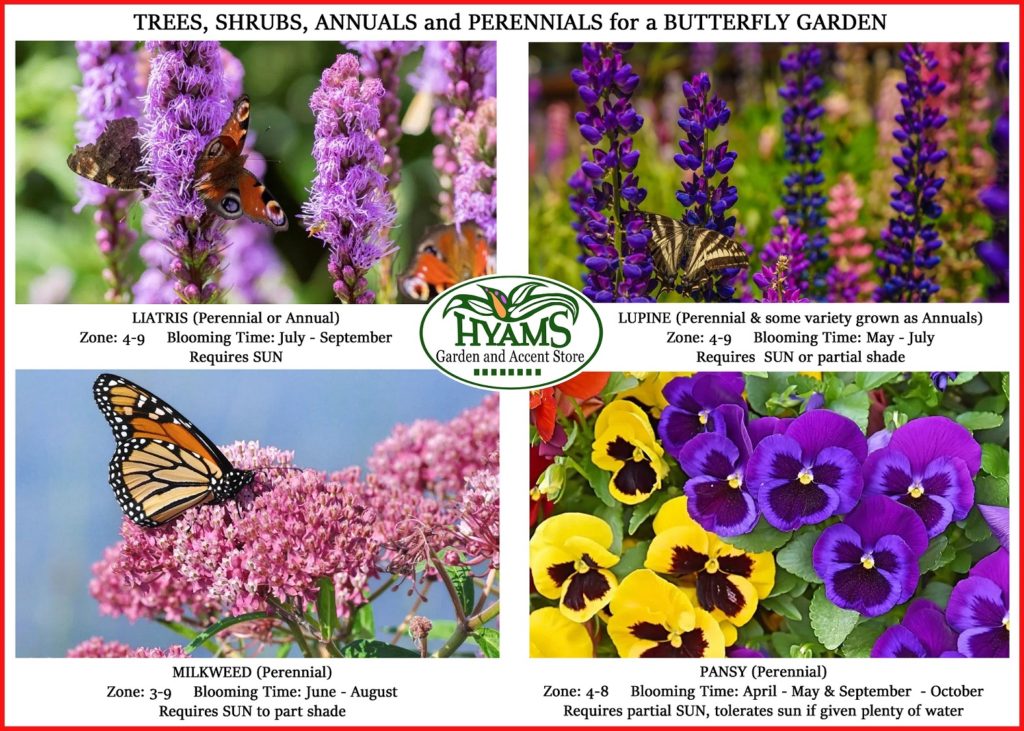
Butterflies play an important role in pollinating plants. They thrive around shrubs, trees, perennials and annuals that provide them nectar. It is a sugary solution that gives adult butterflies their energy. However, a sensible butterfly garden designer also thinks of the caterpillars. They do not eat nectar but live on leaves and plants. Shrubs, trees, vegetables and even pesky weeds are host plants for caterpillars. Female butterflies lay their eggs only on suitable host plants as the emerging young ones cannot travel far to find food. Since caterpillars heavily munch on the plants, it may be a wise gardening strategy to plant them in areas of the garden that are not easily visible to visitors.     

Butterfly Shrubs and Trees

Abelia (glossy)
Buddleia or Butterfly Bush (Buddleia Davidii)
Blueberry (Vaccinium species)
Citrus
Hawthorn (Crataegus species)
Privet (Ligustrum spp.)
Red bud (Crecis)

Butterfly Annuals

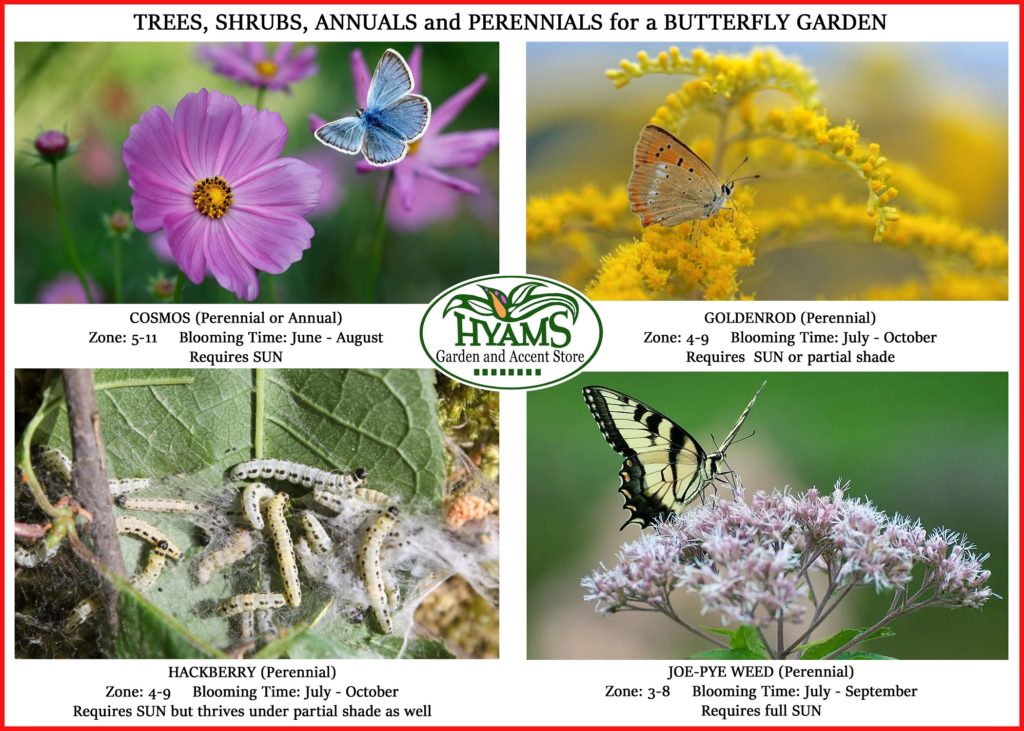
Cosmos
Dill
Fennel
Globe Amaranth (Gomphrena globosa)
Impatiens
Marigolds
Nasturtium
Parsley
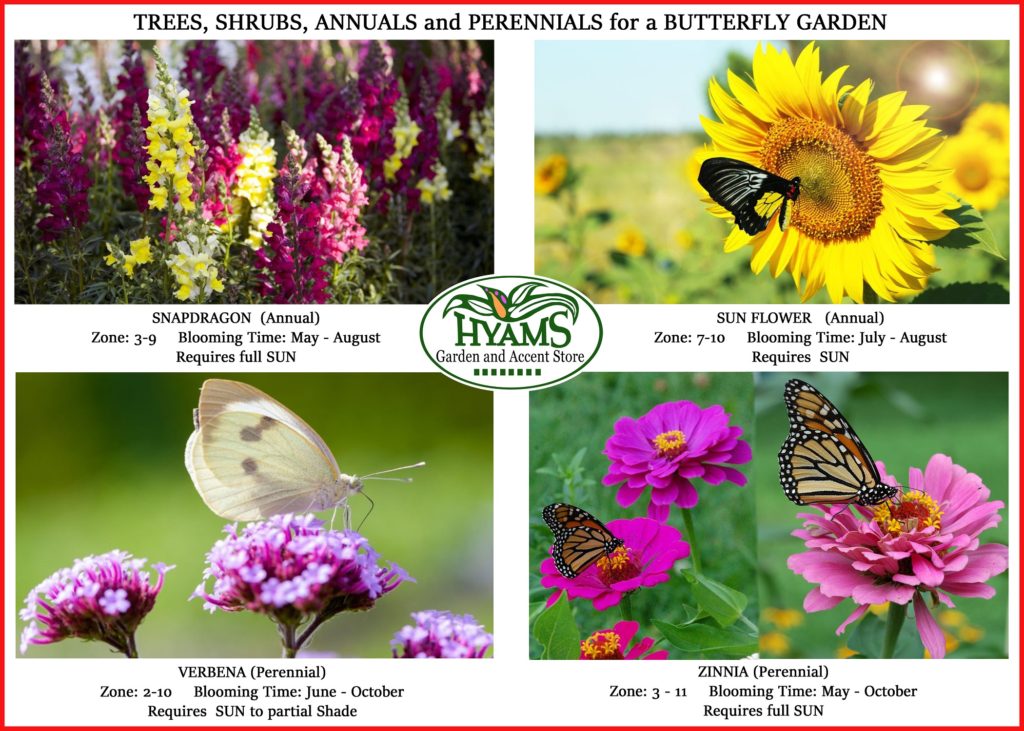
Sunflower
Queen Anne’s lace
Verbena
Zinnia

Butterfly Perennials

Ageratum
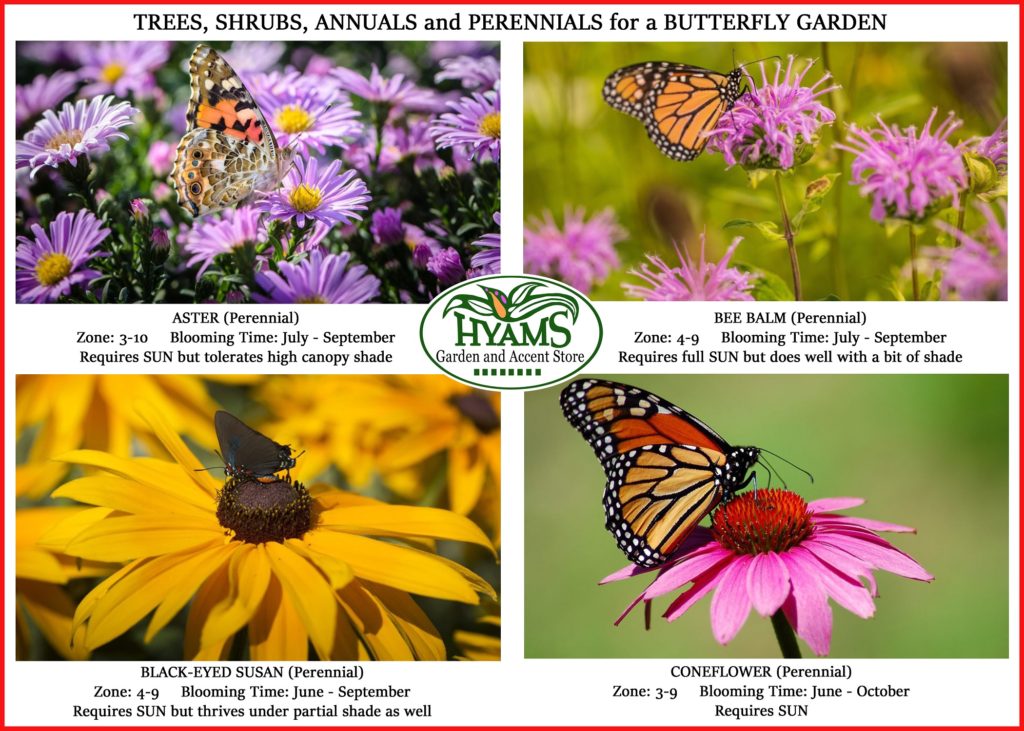
Aster
Bee-balm (Monarda)
Black-eyed Susan (Rudbeckia)
Bugle (Ajuga Reptans)
Butterfly weed (Asclepias tuberosa)
Chives
Coneflower (Echinacea purperea)
Coreopsis
Daylily (Hemerocallis species)
False Indigo (Baptisia australis)
Gayfeather (Liatris species)

Godenrod (Solidago species)
Hibiscus
Hollyhock (Altheaa rosea)
Joe-Pye Weed
Lantana (Lantana camara)
Lobelia (Lobelia cardinalis)
Milkweed (Asclepias species)
Passion Flower (Passiflora)
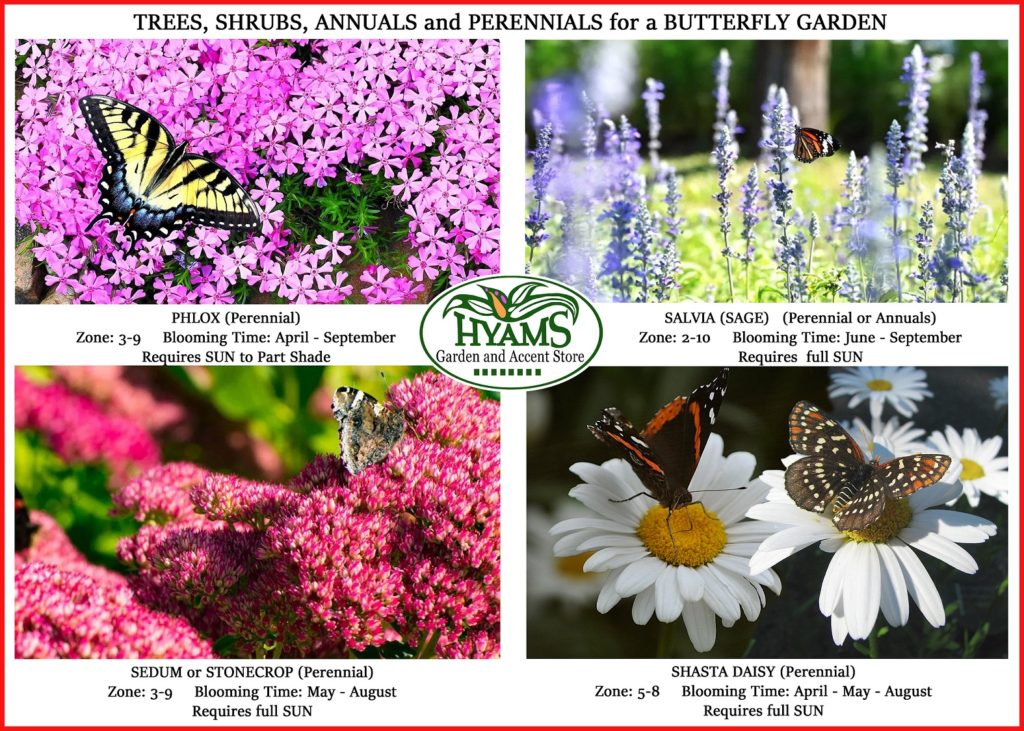
Phlox (Phlox paniculata)
Sage (Salvia leucantha)
Sedum
Verbena
Yarrow (Achillea species)

Filed Under: Garden Center, Gardening Tips, Gardening Wisdom, Green House, What Does the Gardener Say? Tagged With: Annuals for a Butterfly Garden, Butterfly Garden, Caterpillars, Perennials for a Butterfly Garden, Shrubs for a Butterfly Garden, Trees for a Butterfly Garden

  • « Go to Previous Page
  • Page 1
  • Interim pages omitted …
  • Page 7
  • Page 8
  • Page 9
  • Page 10
  • Page 11
  • Interim pages omitted …
  • Page 14
  • Go to Next Page »

Primary Sidebar

Find us on Facebook

Hyams Garden & Accent Store

Recent Posts

  • Flowers to Bring Home in March
  • Grow an Early Vegetable Patch
  • March in the Lowcountry: What to do in the Garden?

Categories

  • Accent and Gift Store
  • Bedding Plants
  • Candles
  • Christmas Décor
  • Christmas Room
  • Christmas Tree Delivery and Set Up
  • Custom Designed Containers, Pots, Window Boxes and Baskets
  • Deliveries and Plantings
  • Diagnostic Center
  • Everyday Gift Items
  • Featured Articles
  • Festive Décor for Various Seasons
  • Fountain Installations
  • Fountains
  • Garden Center
  • Garden Store
  • Gardening Supplies
  • Gardening Tips
  • Gardening Wisdom
  • Green House
  • Hear the Flowers Whisper!
  • Home and Garden Accents
  • Home Décor
  • Join Our Team
  • Life like Botanicals and Flowers
  • Nursery
  • Outdoor Décor
  • Planters and Pots
  • Seasonal Décor
  • Services
  • Special Orders
  • Uncategorized
  • What Does the Gardener Say?
  • Wreathes, Bows and Ribbons

Copyright © 2026 HyamsGardenCenter.com