• Skip to primary navigation
  • Skip to main content
  • Skip to primary sidebar

Hyams Garden Center and Accent Store

Serving Greater Charleston Area with Quality, Variety & Professionalism since 1981

  • Garden Center
    • Plants
    • Fountains, Statuary and Garden Décor
    • Planters & Pots
    • Garden Supplies
    • Hyams Gift Cards
  • Gardening Wisdom
    • Hear the Flowers Whisper
    • What does the Gardener say?
  • Services
    • Delivery and Planting
    • Fountain Installations
    • Custom Designed Pots, Containers & Window Boxes
    • Diagnostic Center
    • Special Orders
    • Christmas Tree Delivery & Set up
  • Accent & Gift Store
    • Home Décor & Gift Items
    • Life like Botanicals and Flowers
    • Wreaths, Bows & Ribbons
    • Candles
    • Seasonal Décor
    • Christmas Décor
    • Greeting Cards for All Occasions
    • Hyams Gift Cards
  • About Us
    • Location and Hours of Operation
    • Contact Us
    • Meet Our Team
  • Inventory
    • Bedding Plants
    • Bulbs
    • Fruit Trees & Plants
    • Garden Supplies
    • Hanging Baskets
    • Nursery
    • Topiaries
    • Trees
    • Tropicals
    • Vegetables & Herbs
    • Water Plants

Gardening Tips

February 12, 2021 By Hyams Garden Center

Pre-emergent Application to Keep your Lawn Weed Free and the grass green

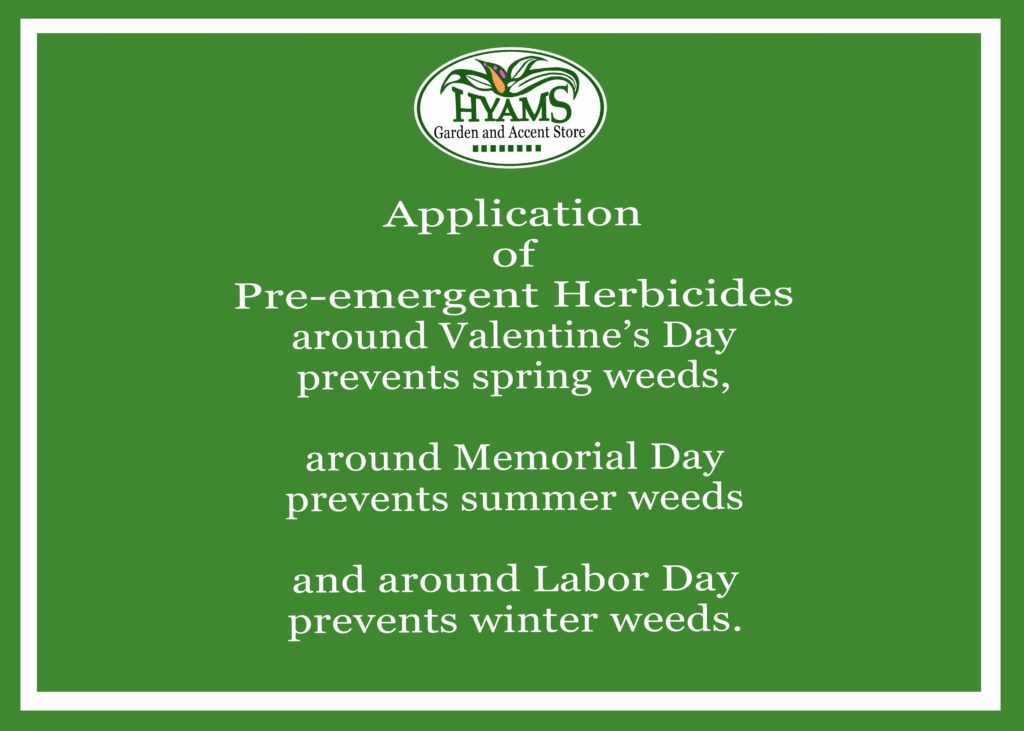
It looks like spring 2021 may wait a few weeks before getting started. It is time to start planning for spring weed prevention and grass greening up. The advantage of applying a pre-emergent herbicide is that it is able to prevent the seeds of those pesky spring weeds from even getting started. Remember, DO NOT APPLY A PRE-EMERGENT HERBICIDE IF YOU PLAN TO SEED YOUR YARD. It will have the same effect on grass seed! In general terms the times to apply pre-emergent herbicides are Valentine’s Day to prevent spring weeds, Memorial Day to prevent summer weeds and Labor Day to prevent winter weeds.
Spring application is most effective when the pre-emergent is applied as daytime temperatures reach 65-70° F for 4 consecutive days. That is usually between February 14th and March 1st.  Herbicide should then be watered in with half an inch (½”) of water to activate. The type of pre-emergent to use should be based on what type of weeds you have. Scotts Halts works very well on crabgrass and other grassy weeds. The 10 lbs bag that costs $24.95 will cover up to 5000 square feet and should not be applied to landscaped beds. By the way, the Scotts product is now called WeedEx with Halts.  
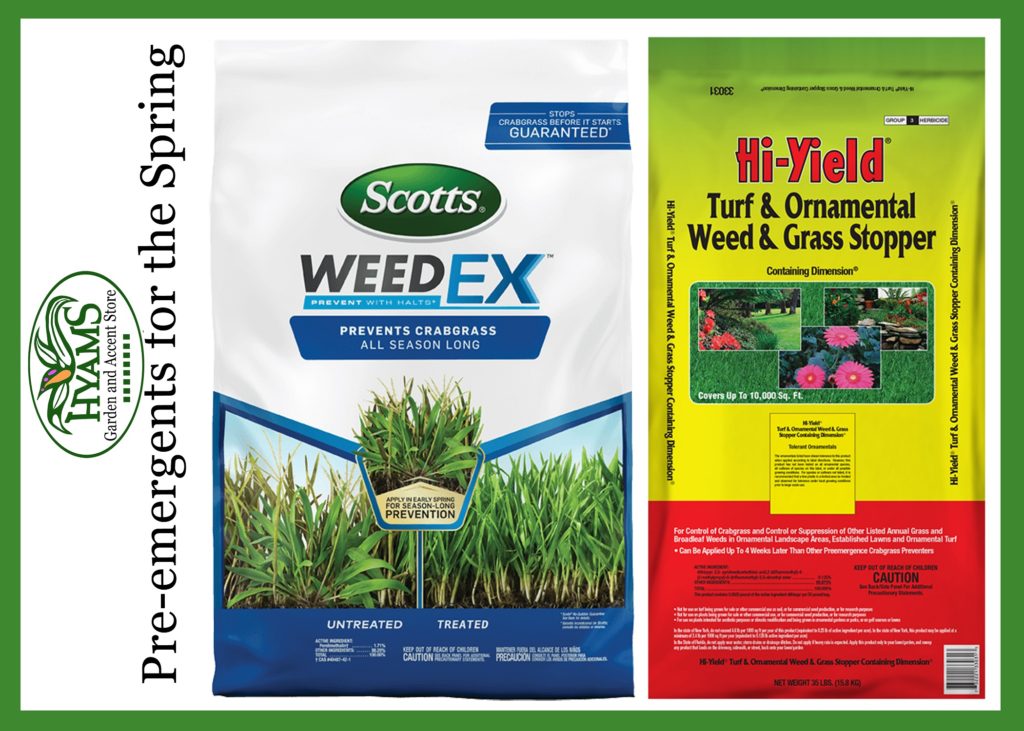
Hi-Yield Turf & Ornamental Weed & Grass Stopper works well to prevent many broadleaf and grassy weeds, including crabgrass, and can be used on landscape plants listed on the label. The 12 lbs bag that costs $14.95 will cover up to 3500 sq. ft. An organic option would be Espoma Weed Preventer made from corn gluten. A 25 lbs bag costs $39.95 and covers 1200 square feet. It has some nitrogen as a fertilizer component in it too. We have several other options, bring in pictures or samples of the problems you are dealing with when you visit Hyams Garden Center diagnostic desk and we’ll figure out the best course of action.

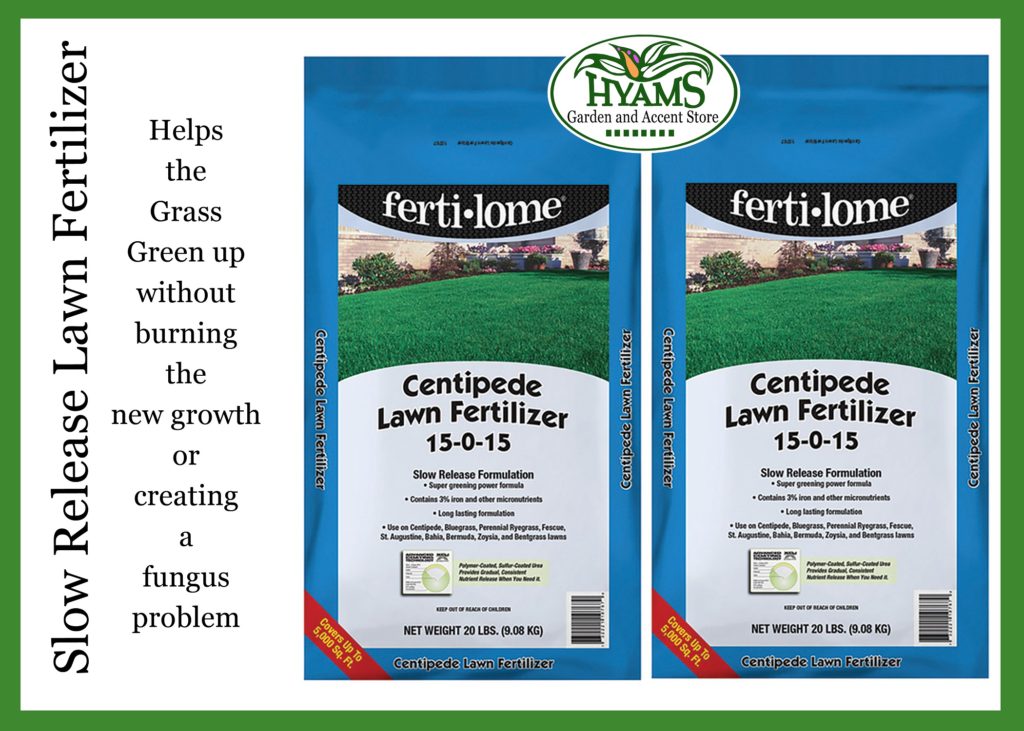
As you move into late March early April, you will see the warm season grasses start to green up. Please resist the urge to apply a weed and feed at that time, as the post emergent component and the high nitrogen levels could easily burn the new growth. After you have cut the grass a couple of times an application of a slow release lawn fertilizer such as Ferti-lome 15-0-15 Centipede Lawn Fertilizer will help the grass to green up slowly, not burning the new growth or contributing to fungus problems. The 20 lbs bag which costs $25.95 will fertilize up to 5000 square feet.
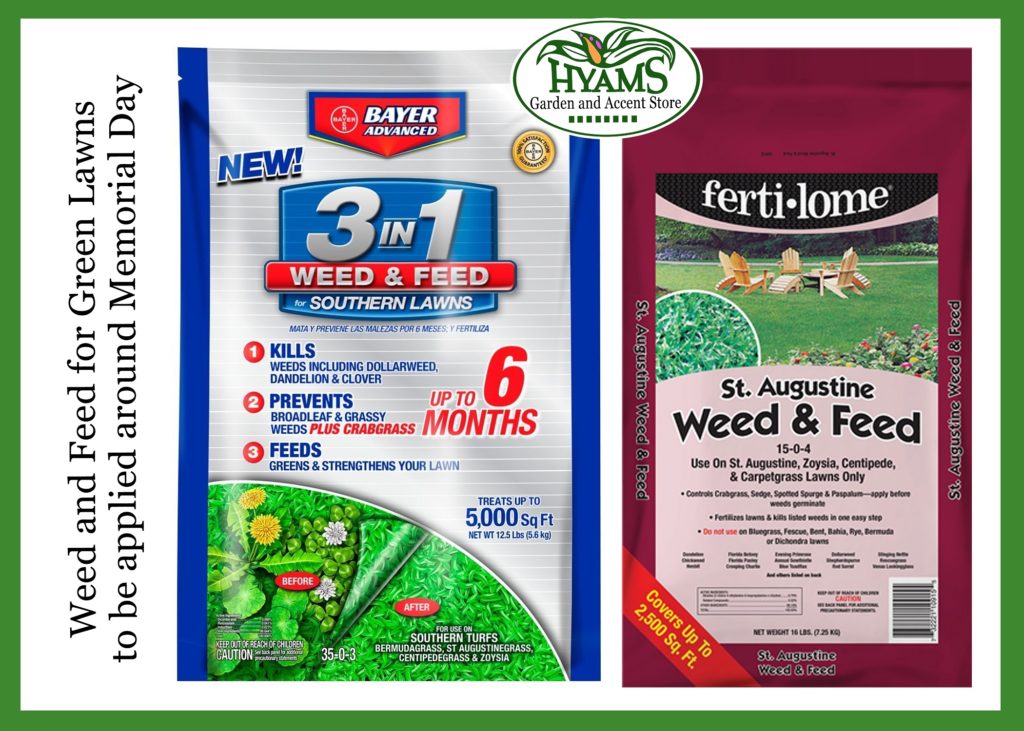
Once fully greened up and actively growing, you can apply a weed and feed such as Ferti-lome 15-0-4 St. Augustine Weed and Feed or Bayer 35-0-3 3 in 1 Weed and Feed for your Memorial Day application.
Be sure to read the labels of all these products and follow the direction carefully. Please feel free to come by, e-mail (rhowie@hyamsgardencenter.com) or call me (843-795-4570) if you have any questions or concerns. Thank you and I look forward to helping you.

By Randy Howie
Filed Under: Gardening Tips, Gardening Wisdom, What Does the Gardener Say? Tagged With: Espoma Weed Preventer, Ferti-lome 15-0-15 Centipede Lawn Fertilizer, Ferti-lome 15-0-4 St. Augustine Weed and Feed, Hi-Yield Turf & Ornamental Weed & Grass Stopper, Pre-emergent Herbicides, Pre-emergent to keep Lawns Weeds Free, Scotts WeedEx

January 18, 2021 By Hyams Garden Center

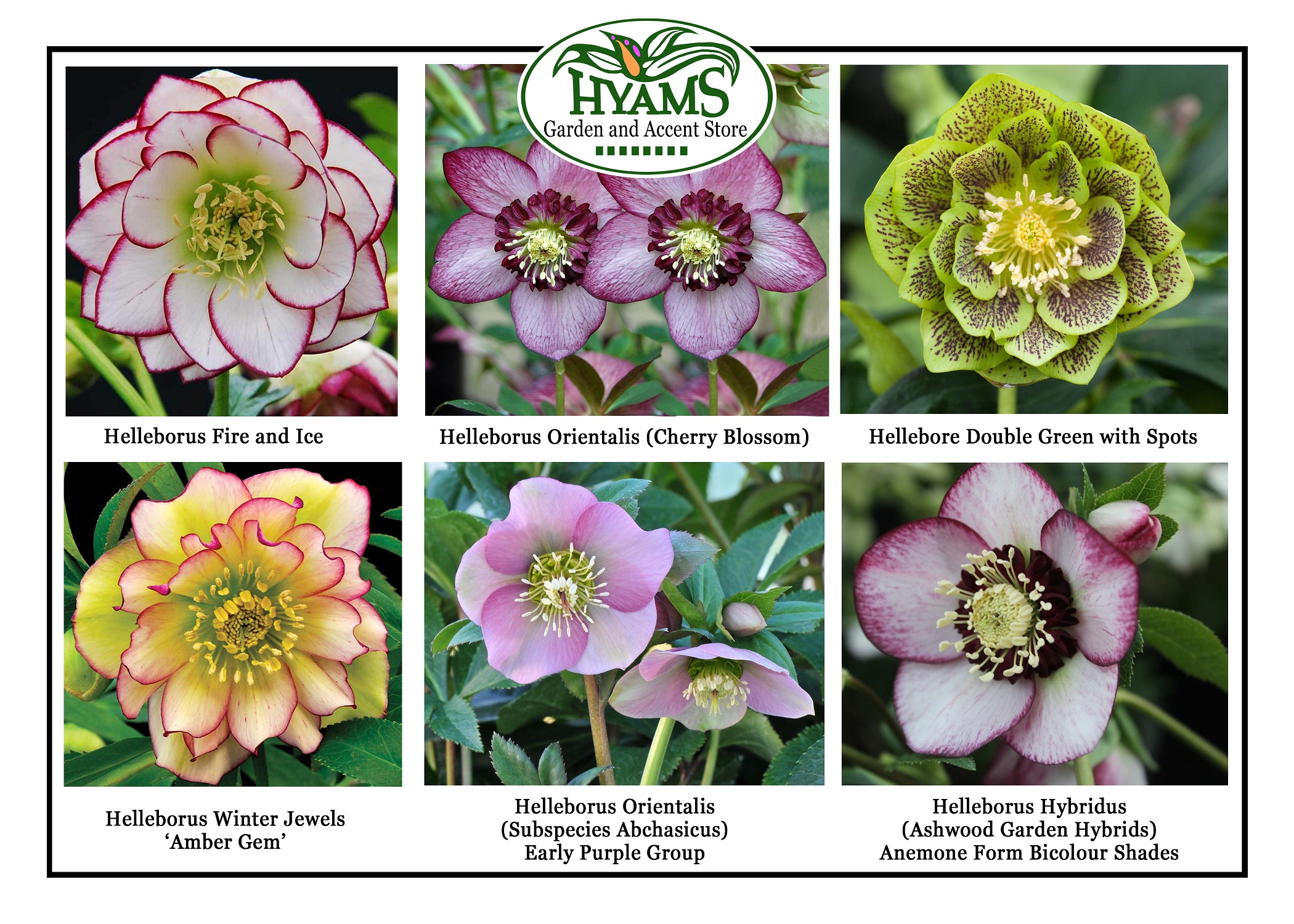
Lenten Roses (Helleborus Orientalis)

Helleborus Orientalis is one of the earliest flowering perennials. It blooms in February or March and is seen as a true harbinger of spring. Because it usually blooms during Lent, Helleborus Orientalis is called Lenten Rose. People living in places where winter is severe, plant Helleborus near the kitchen window, patio or walkway so that they can enjoy the early bloom to their hearts’ content.

Belonging to the ‘Ranunculaceae Family,’ HELLEBORUS, a Eurasian genus, consists of approximately twenty species of herbaceous or evergreen perennial flowering plants. The name Helleborus is derived from the Greek words elein meaning ‘to injure’ and bora meaning ‘food,’ a direct reference to the fact that the leaves, stems and roots of Helleborus plant are poisonous to humans if ingested. The sap may cause skin irritation as well.

Lenten Roses are in fact cultivars that are hybrids between Helleborus Orientalis and other species. Their flowers last for a few months and are available in a range of whites, yellows, pinks, and purples, often spotted or with darker edges. Most varieties of Lenten Roses are evergreen, with large, toothed, divided leaves. They prefer semi-shade and moisture retentive, well-drained and neutral to alkaline soil. They flourish in the shade of high-branched trees or on the north or east side of buildings. However, they need protection from strong, winter winds. Lenten Roses naturally hybridize and self seed. Most deciduous species retain their old leaves over winter. These leaves should be cut off in early spring as flower buds develop. They are excellent in woodland gardens. Ashwood Garden hybrids, Bradfield hybrids and Harvington hybrids are some of the common Helleborus Orientalis subspecies that are available as Lenten Roses.  Typically sold in autumn, Helleborus can be planted year round and Southern Wood Fern is a good companion plant for it. 

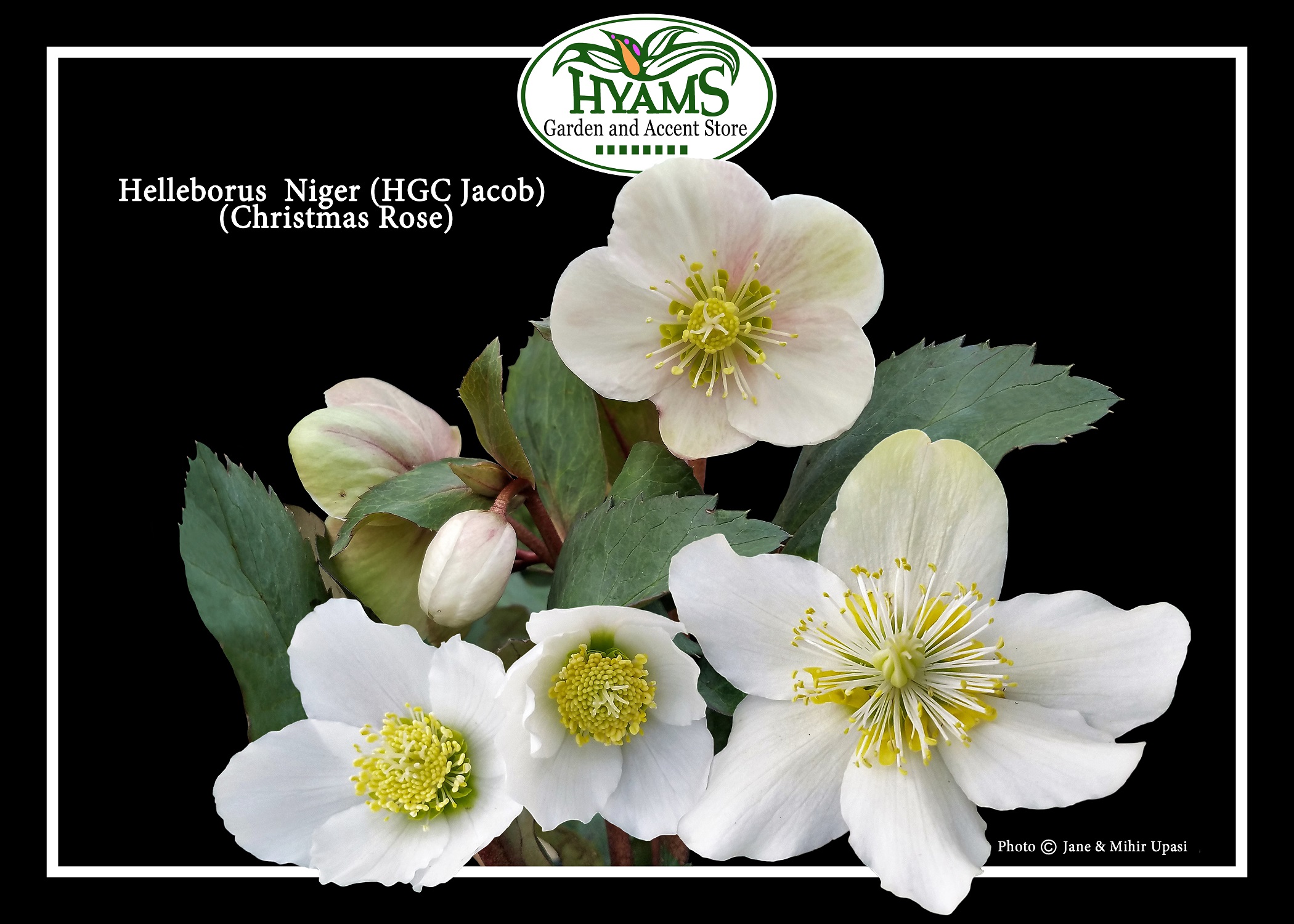
Celebrated in songs and stories, Helleborus Niger (Black Hellebore) is commonly known as Christmas Rose as it blooms in winter. It too is an evergreen perennial with large, bowl shaped glistening white flowers with golden stamens. They grow in zone 4 to 8 and ‘HGC Jacob’, ‘HGC Josef Lemper’ and ‘Potter’s Wheel’ are some of the common species of Christmas Roses. 

The 2019 Edition of Encyclopedia of Plants and Flowers, edited by Christopher Brickell lists some of the following Helleborus species:

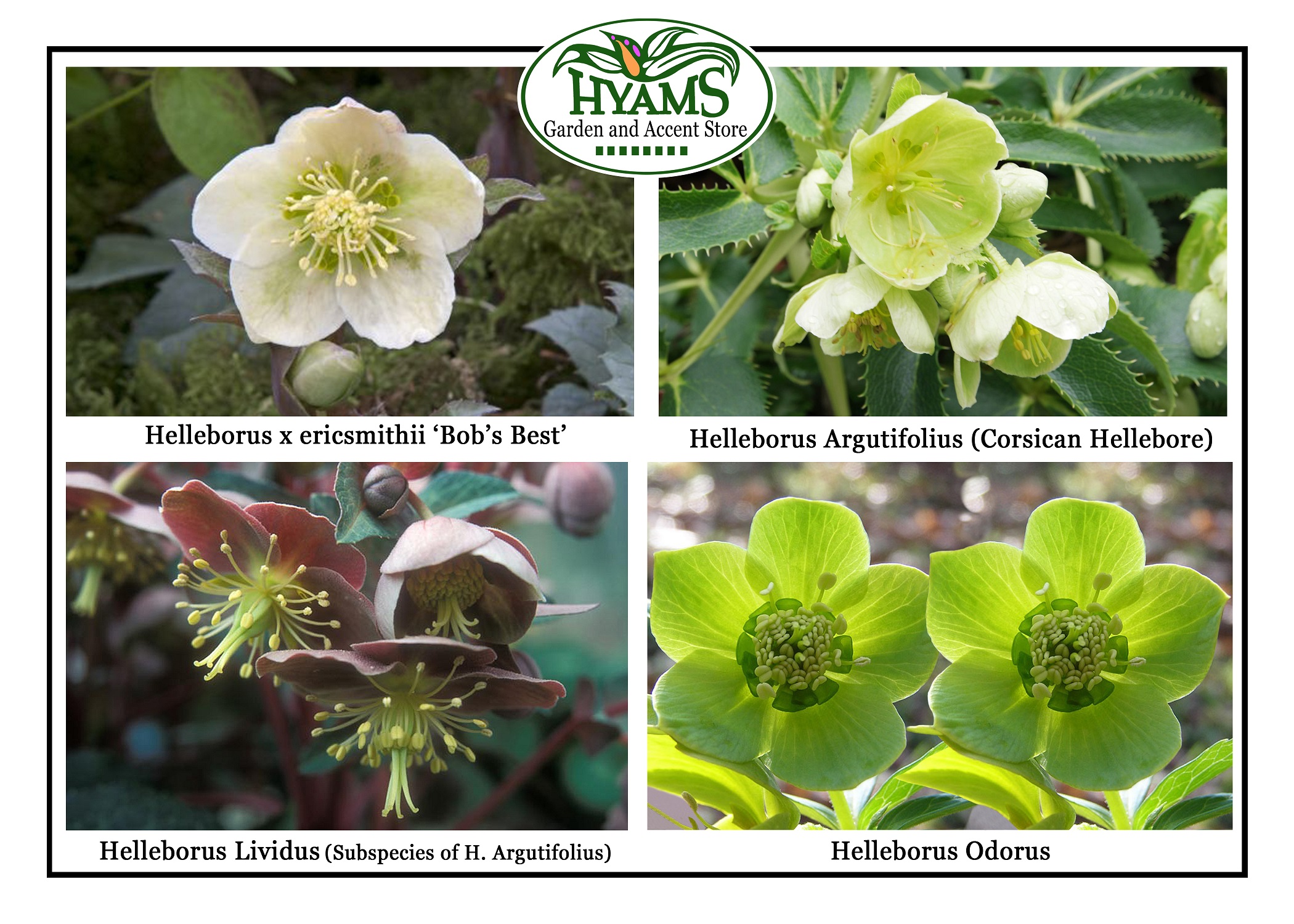
Helleborus x ericsmithii ‘Bob’s Best’ is an evergreen, clump-forming perennial with toothed, green leaves flushed in pewter and divided into 3-5 leaflets. From midwinter to late spring it bears saucer-shaped, pink-tinted, white flowers. It prefers partial shade, well-drained soil and is fit for zones 6 to 9.

Helleborus Argutifolius, synonymously called Helleborus Corsicus or Corsican Hellebore is an evergreen, clump forming perennial. It has divided, spiny, dark green leaves. Cup-shaped, pale green flowers are borne in large clusters in winter and spring. This species grows in zone 6 to 9.

Helleborus Lividus is a subspecies of Helleborus Argutifollius. It is an evergreen, clump-forming perennial. It has three-lobed, mid green leaves, marbled pale green, and purplish-green below with obliquely ovate, slightly toothed or entire leaflets. It produces large clusters of cup-shaped, purple-suffused, yellow-green flowers in late winter. This species grows in zone 8 and 9.

Helleborus Odorus is a semi-evergreen, clump-forming perennial with deeply divided, deep green basal leaves, hairy beneath with five central leaflets. From early winter to early spring this species bears clusters of three to five fragrant, saucer-shaped, bright green to yellow-green flowers. It prefers partial shade and moist soil and grows in zones 4 to 8.

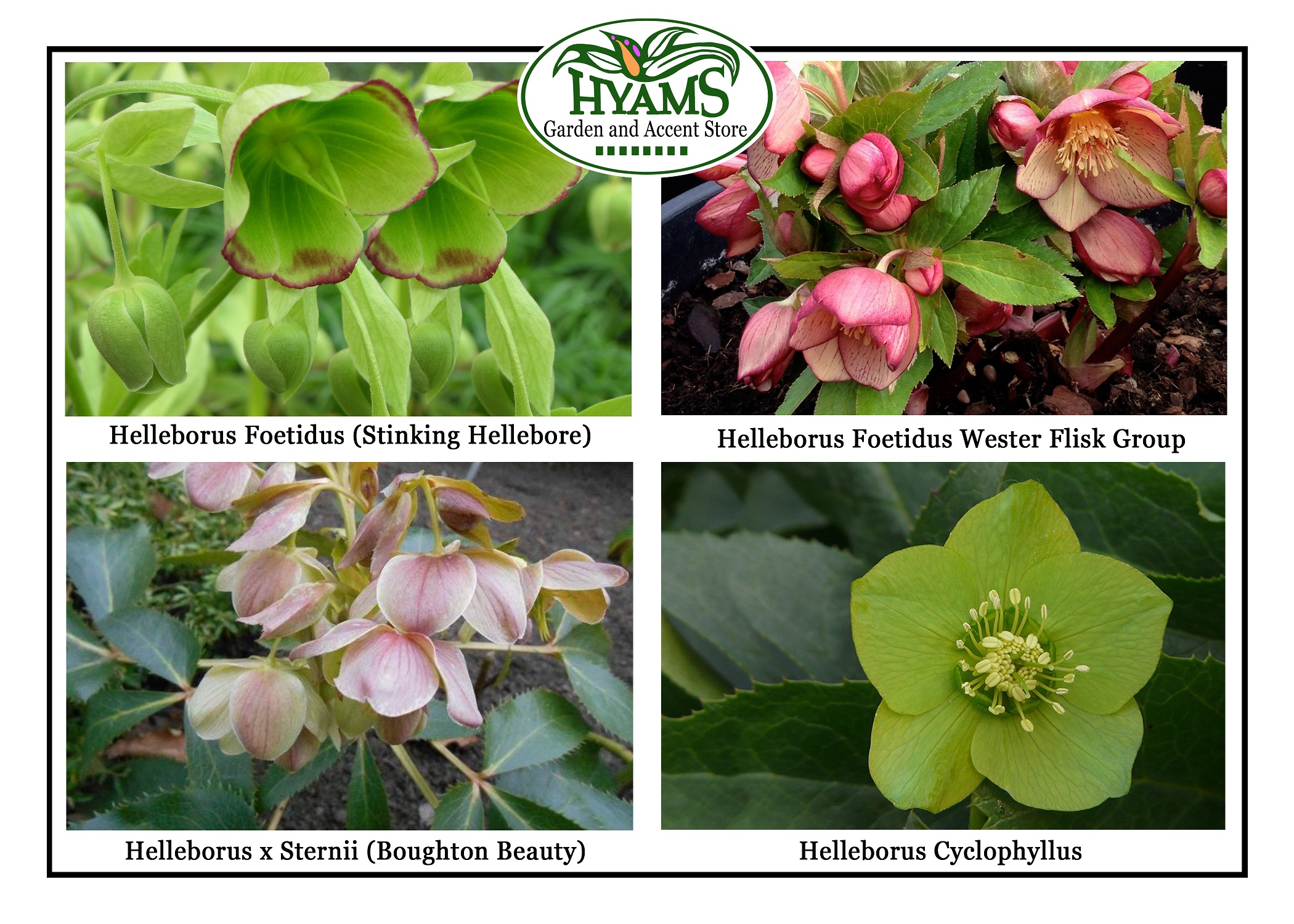
Helleborus Foetidus (Stinking Hellebore) is an evergreen, clump-forming perennial with deeply divided, dark green leaves. In late winter and early spring panicles of cup-shaped, red-margined, pale green flowers bloom on this plant. It prefers partial shade and well-drained soil and grows in zones 6 to 9.

Helleborus Foetidus Wester Flisk Group is an evergreen, semiwoody perennial. In winter and spring it bears small cup-shaped, purple-rimmed pale green flowers on floppy, red-green stems. It has red-stalked, dark gray green leaves divided into slender, slighted toothed leaflets. It prefers partial shade and moist soil and grows in zones 6 to 9.  

Helleborus x Sternii (Boughton Beauty) is an evergreen, clump-forming perennial with purple-pink stems and divided veined, mid green leaves. It winter and early spring it bears cup-shaped, pink-purple flowers with green insides in terminal clusters. This species prefers partial shade and moist soil and is fit for zones 5 to 8.

Helleborus Cyclophyllus is a clump-forming perennial with palmate, deeply divided, bright green leaves. In early spring, this species produces shallowly cup-shaped, yellow-green flowers with prominent, yellowish-white stamens. It prefers partial shade and moist soil and grows in zones 6 to 9.  

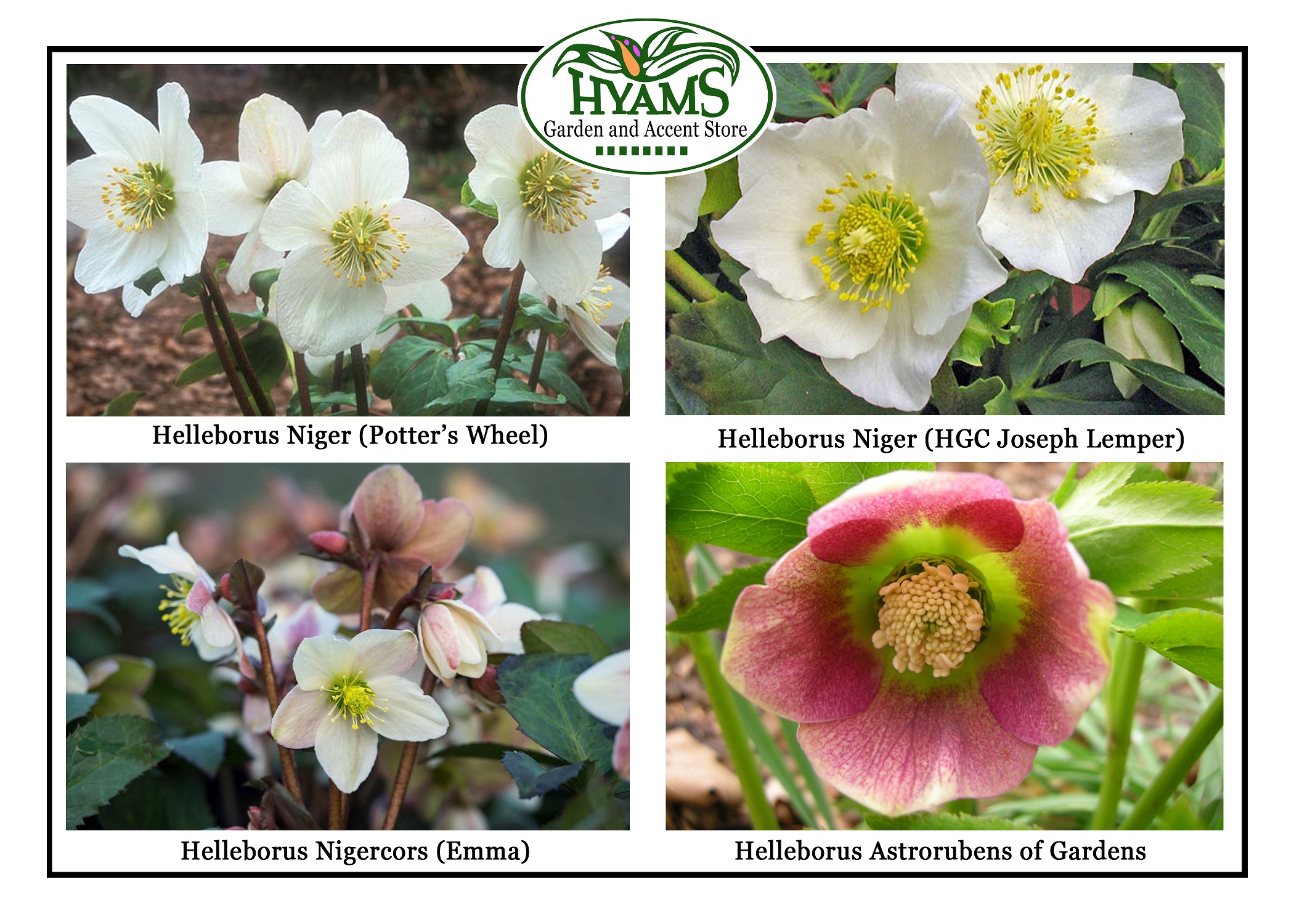
Helleborus Niger (Potter’s Wheel) is an evergreen, clump-forming perennial with divided, deep green leaves. In winter or early spring it bears cup-shaped, nodding, pure white flowers with overlapping petals and green “eyes.” This plant prefers partial shade and well-drained soil and is fit for zones 4 to 8.

Helleborus Niger (HGC Joseph Lemper) is an evergreen, clump-forming, upright perennial with divided, rich dark green leaves. From mid-fall to late winter it bears slightly fragrant, rounded, pure white flowers with overlapping petals on sturdy stems. This plant prefers partial shade and well-drained soil and is fit for zones 4 to 8.

Helleborus Nigercors (Emma) is a compact, evergreen, clump-forming perennial. It has matte green leaves. It freely bears branched clusters of saucer-shaped white flowers that age to grayish-pink from midwinter to early spring. It prefers partial shade and well-drained soil and is fit for zone 4 to 9.

Helleborus Astrorubens of Gardens or synonymously known as ‘Early Purple Groups’ is a clump-forming perennial and has palmate, deeply divided, toothed, glossy, dark green leaves. It is a subspecies of Helleborus Orientalis Abchasicus. In late winter it bears shallowly cup-shaped, deep purple flowers. It is fit for zones 4 to 8.

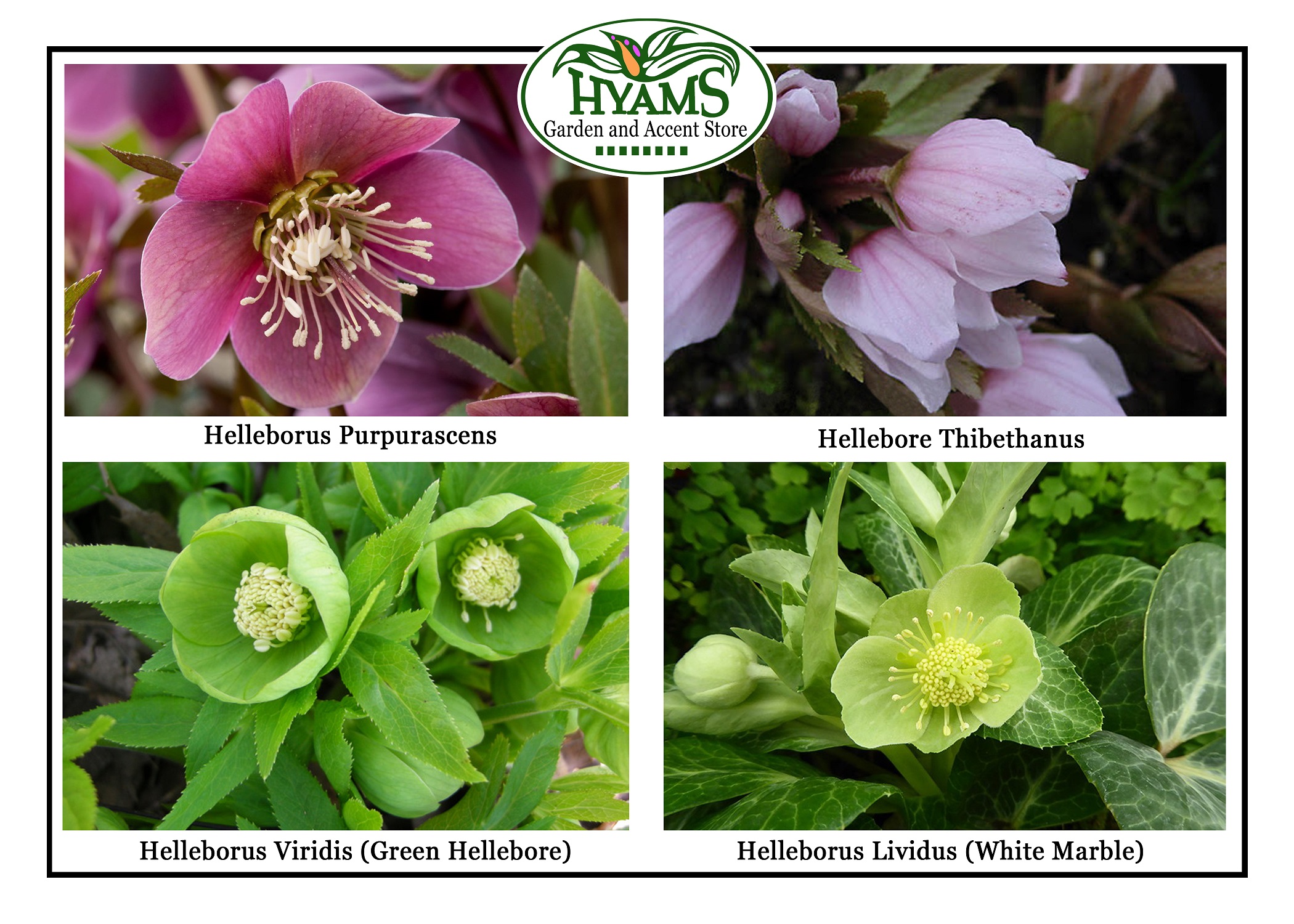
Helleborus Purpurascens is a neat clump-forming perennial. In early spring it bears small, nodding, cup-shaped, deep purple or green flowers splashed with deep purple on outside. It has dark green leaves that are palmate and deeply divided into narrowly lance-shaped, toothed segments. This plant prefers partial shade and moist soil and is fit for zones 4 to 8.

Hellebore Thibethanus is a clump-forming perennial with palmate mid-green leaves deeply divided into 7 to 9 toothed lobes. In late winter and early spring it bears deeply cup-shaped flowers that vary from white to white with pink veins, which darken with age. This plant prefers partial shade and moist soil and is fit for zones 5 to 8.

Helleborus Viridis (Green Hellebore) is a deciduous clump-forming perennial that has dark divided green leaves. Fit for zones 6 to 9, this plant bears cup-shaped green flowers.

Though Helleborus Orientalis is called Lenten Rose and Helleborus Niger is called Christmas Rose, this perennial is not a rose at all. It is called as such because the flowers somewhat resemble a small single rose and bloom in early spring. Lenten Rose symbolizes serenity, tranquility and peace. On the other hand, it can also represent a scandal or anxiety. Christmas rose, on the other hand, represents purity. That is why it has often been carved into confessionals as a five-petal flower. The symbolic significance being a penitent who goes into the confessional to seek forgiveness for sins, walks away having his or her purity restored.

By Marshal and Jane Upasi

Filed Under: Garden Center, Gardening Tips, Gardening Wisdom, Hear the Flowers Whisper!, What Does the Gardener Say? Tagged With: Ashwood Garden hybrid Hellebores, Christmas Roses, Helleborus Orientalis, Helleborus x Hybridus, Lenten Roses

January 2, 2021 By Hyams Garden Center

Fountain Maintenance

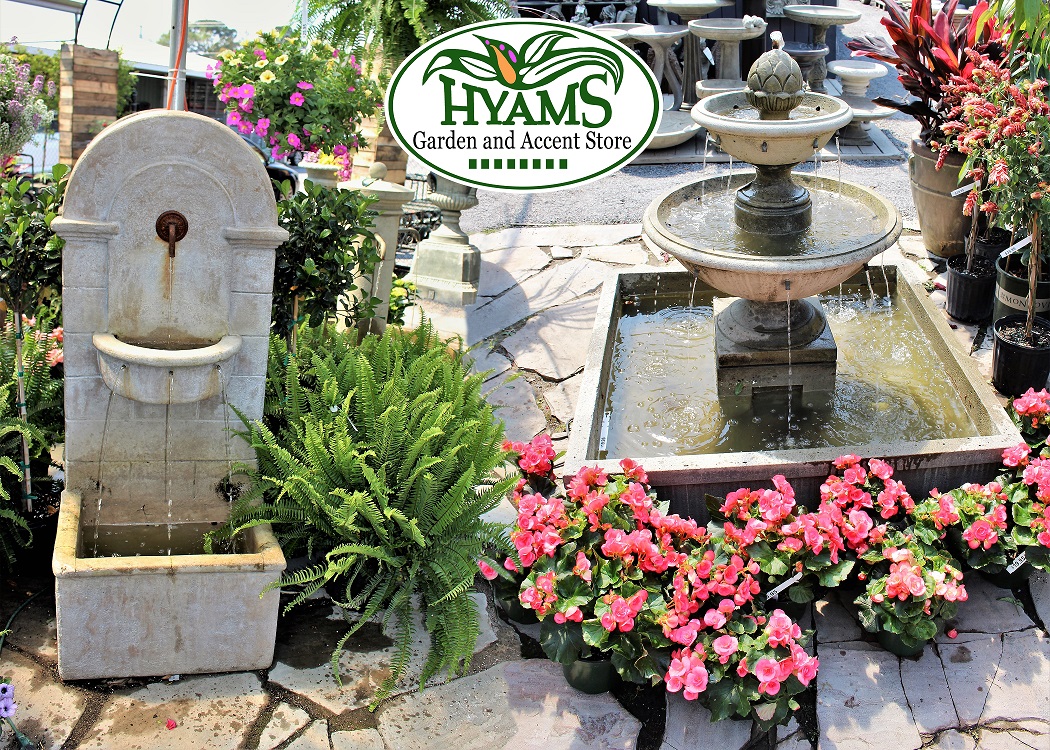
Here is how one needs to take proper care of all cast stone fountains:

Ensure that the pump always remains submerged. In order to do that consistently fill the fountain and maintain a proper water level. When the water level is too low, the pump runs the risk of being damaged. The frequency of filling the water depends on water flow and specific weather conditions in which the fountain runs. Proper fountain performance also depends on appropriate water level.

Pump inflow needs to be kept free of debris to ensure proper water inflow. Cleaning it periodically will let your pump last longer.

Use a mild soap and a soft bristle brush if the fountain requires a cleaning. Do not use bleach as it may affect the patina.

Hyams Garden Center carries “Algaecides” if one needs to combat the buildup of algae.

Hyams Garden Center is always ready take your calls ( 843-795-4570) if you have any questions concerning your fountain. For problems that cannot be remedied over the telephone, an onsite visit can be scheduled. You will be charged a minimum $50 fee for each onsite consult.   

Filed Under: Fountains, Garden Center, Gardening Tips, Uncategorized, What Does the Gardener Say?

October 3, 2020 By Hyams Garden Center

Maintaining a Healthy Hydrangea

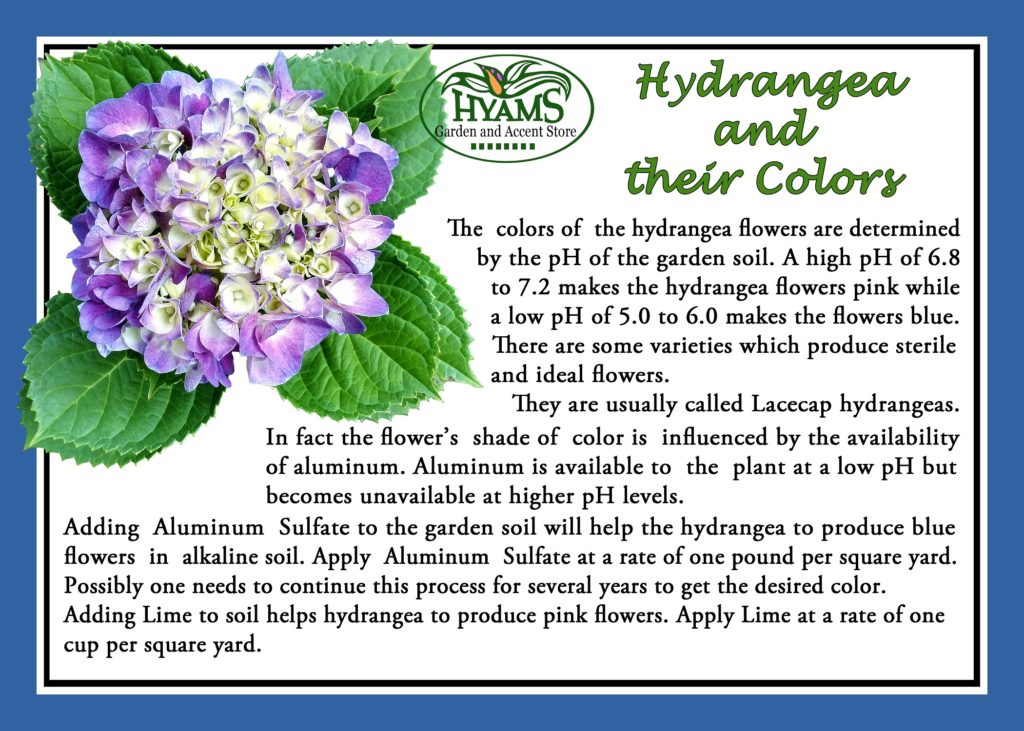
The beautiful Hydrangea is a spectacular, colorful, floral display that adds charm and grace to any summer garden. Hydrangea derived its name from two Greek words, namely, hydr (water) and angeion (vessel). Water vessel is such a fitting name for hydrangea as this flower requires constant moisture to stay happy, healthy and blooming.  However, getting the balance right is crucial to its health and survival.

There are some common signs and symptoms to look for in order to provide the best environment for your Hydrangea to thrive.

  1. Leaf Curl indicates that the plant has either been water deprived or is suffering from a disease.
  2. A sudden onset of ‘Yellowing of Leaves’ which then turn brown and fall off can indicate three things, namely, (a) the plant has become too dry; (b) the plant has become too wet; (c) the plant has received too much fertilizer.

Any of these three events can cause damage to the plant’s root system. If a plant has dried out, thoroughly soak the root ball, then make sure the soil is able to drain well. Allow time for soil to dry out slightly before the next watering. If conditions are favorable, roots will regenerate. A plant should be healthy before adding any fertilizer. Too much fertilizer can burn roots causing leaves to brown.

3. Leaf Spots are usually caused by fungus or bacteria.

(a) Cercospora Leaf Spot – Caused by a fungus, produces purple or brown colored leaf spots at the base of the plant.

(b) Anthracnose – Caused by a fungus, creates large brown, yellowish or black spots on leaves and flowers. If not properly attended to, this can be fatal to a hydrangea. Remove and destroy infected plant parts to discourage spreading of spores.

(c) Leaf Rust – Caused by a waterborne fungus, Pucciniastrum hydrangea, creates orange spots on the undersides of leaves.

(d) Bacterial Leaf Spots – Caused by the pathogen Xanthomonas campestris, produces spots that are either red or purple in color usually appearing on the leaves at the base of the plant. Spots by the leaf veins have an angular appearance.

4. Powdery Mildew – Caused by a fungus, appears as a powdery gray coating on leaves.

For fungal and bacterial mitigation, make sure there is enough air circulation around the plant. Cut back dried blooms and affected leaves. Keep the ground under the plant free from dead leaf and bloom debris. Water plant at the base rather than overhead to discourage moisture accumulation on the leaves. Fungicides can also be used. Apply in Spring and Mid-Summer. Application frequency depends on the severity of the case. Consult the product packaging for details.

BONIDE Revitalize Biofungicide is a broad-spectrum preventive biofungicide and bactericide. It utilizes the power of a naturally occurring beneficial bacterium, Bacillus amyloliquefaciens strain D747, to control and suppress fungal and bacterial diseases in plants. This bacterium triggers the plant’s immune response to fight off pathogens. It will also colonize plant roots, which prevents fungi and bacteria from establishing there.

Diseases controlled by this product:

Anthracnose (Colletotrichum species), Bacterial leaf blights, spots and specks (Erwinia, Pseudomonas and Xanthomonas species), Black Mold, Brown Spot, Black Crown Rot (Alternaria species). Black Spot of roses (Diplocarpon rosae), Gray Mold, Botrytis blight, Fruit Rot (Botrytisspecies), Leaf spots (Alternaria, Cercospora, Entomosporium, Helminthosporium, Myrothecium and Septoris species) and Powdery Mildews. (Podosphaera, Erysiphe, Golovinomyces, Sphaerotheca and Oidium species; Uncinula necator, Oidiopsis taurica and Leveillula taurica).

Filed Under: Gardening Tips, Gardening Wisdom, What Does the Gardener Say?

  • « Go to Previous Page
  • Page 1
  • Interim pages omitted …
  • Page 13
  • Page 14
  • Page 15
  • Page 16
  • Page 17
  • Page 18
  • Go to Next Page »

Primary Sidebar

Find us on Facebook

Hyams Garden & Accent Store

Recent Posts

  • The Charleston Garden in Transition: Beauty Between Summer and Autumn
  • A New Season Begins: Planting for Fall in the Lowcountry
  • Before the Weeds Wake: Preparing Your Charleston Lawn for Fall

Categories

  • Accent and Gift Store
  • Bedding Plants
  • Candles
  • Christmas Décor
  • Custom Designed Containers, Pots, Window Boxes and Baskets
  • Diagnostic Center
  • Everyday Gift Items
  • Featured Articles
  • Festive Décor for Various Seasons
  • Fountain Installations
  • Fountains
  • Garden Center
  • Garden Store
  • Gardening Supplies
  • Gardening Tips
  • Gardening Wisdom
  • Green House
  • Hear the Flowers Whisper!
  • Home and Garden Accents
  • Home Décor
  • Join Our Team
  • Life like Botanicals and Flowers
  • Nursery
  • Outdoor Décor
  • Planters and Pots
  • Seasonal Décor
  • Services
  • Statuary
  • Uncategorized
  • What Does the Gardener Say?
  • Wreathes, Bows and Ribbons

Copyright © 2026 HyamsGardenCenter.com